Hello anyone who happens to be reading this! I haven't posted on this blog in f o r e v e r, but I really want to start writing again. So, I started another blog over at Among The Birches. Go check it out!
Friday, May 19, 2017

Monday, November 23, 2015
Florida Trip 2015!
I was in the beautiful state of Florida for much of last week, officially to visit a college, but of course it turned into more of a birding trip. The college I was visiting is in Collier county, which is not wanting in the birds department by any means. The trip started on a definite positive note, with about 50 Roseate Spoonbills (lifer!) seen from the plane just before touching down in Fort Myers. After driving down to Naples, my dad and I decided to take a late afternoon walk at Corkscrew Swamp Sanctuary, which I'd heard many good things about. I was really hoping for a Painted Bunting or a Limpkin, but no such luck. But--I did get my lifer Wood Stork, a bird I'd wanted to see for a long time. Sadly, though, it was a flyover and I didn't get any photos.
I did, however, get quite a bit of photos of other random things in the swamp:

Close to the end of our walk, I got one of the most welcome lifers I've had in a while: Palm Warbler (in a palm tree, appropriately). There are no words to describe the frustration these warblers have given me in the past, as they were my long-time nemesis. Finally, I emerged victorious. And proceeded to see about 54782397318 more of them in the following days. Ah, well. 'Tis the nature of nemeses.
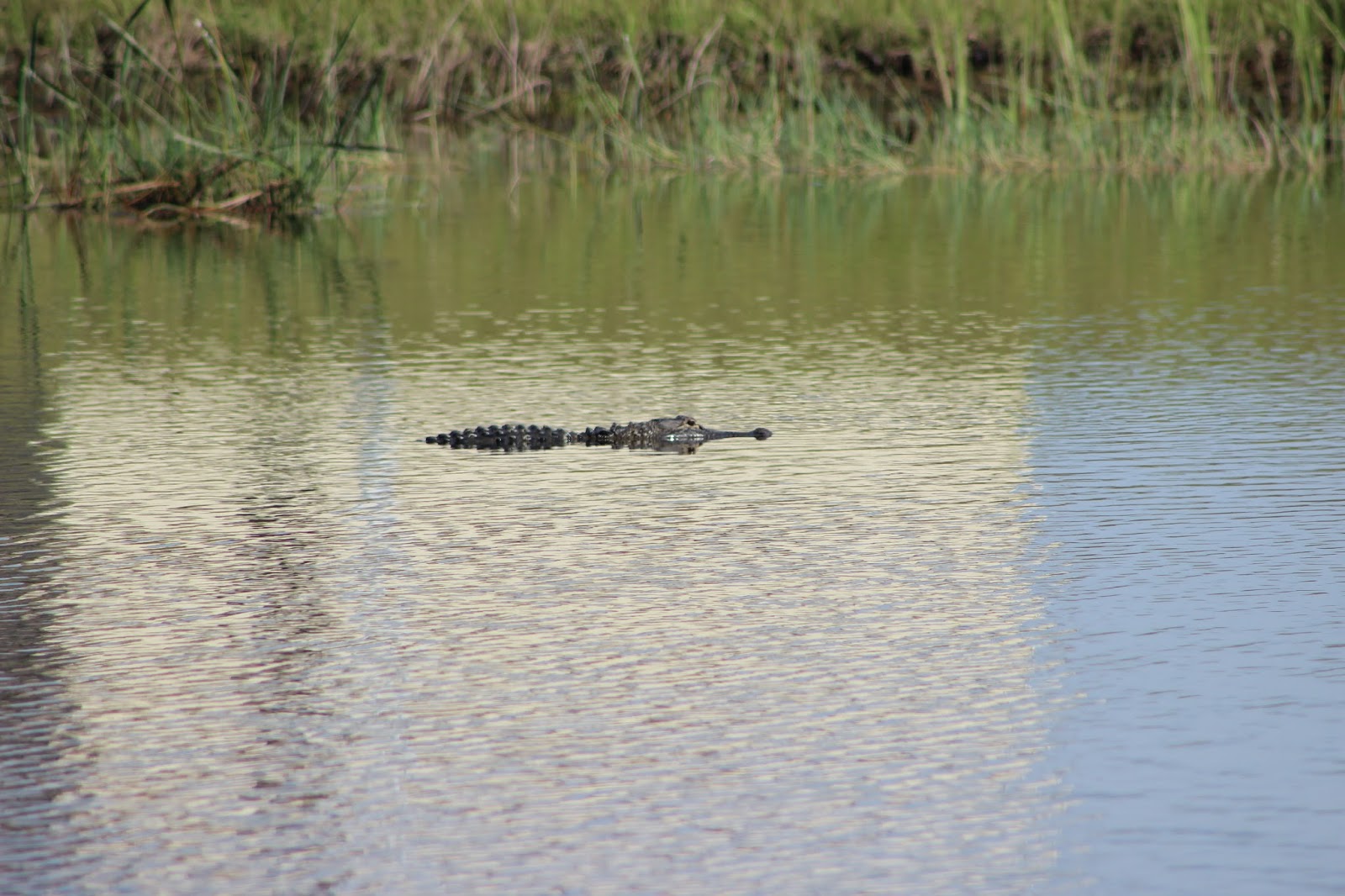
The next day I took a tour of the college and found that its campus was not too shabby as far as nature goes. I saw two Loggerhead Shrikes just hanging out, an alligator in the canal next door, a Tricolored Heron in one pond, and many, many Anhingas. I could take four years of that.

After completing my college visit, my dad and I headed down to the beach at Delnor-Wiggins Pass State Park. I was happily photographing the Willets, Sanderlings, Black-bellied Plovers, and Ruddy Turnstones when I happened to glance up at the sky and saw nothing other than a Magnificent Frigatebird! I almost squealed out loud. I remember reading about MAFRs when I was about ten years old and dreaming of some point in the far future when I would actually see one. Six years later, I was looking right at a beautiful male.
The next day, Thursday, my dad and I drove over to the Fort Lauderdale/Miami area because my dad had a meeting there on Friday. We were surprised to find our hotel was right on the beach, whereas we had thought it was a block or two away. We weren't complaining.
Walking along the beach yielded large numbers of Laughing Gulls, Willets, Black-bellied Plovers, Sanderlings, and Ruddy Turnstones. (And let's not forget the pigeons. Pigeons everywhere.) Also present were Royal Terns, Western Sandpipers, and a lone Herring Gull. To close out our walk, who should make an appearance but another Magnificent Frigatebird!
Friday morning meant sitting on the balcony in my pajamas while my dad was at his meeting, scanning the beach with my binoculars. As well as the usual suspects I had counted the day before, I saw Eurasian Collared-Doves, Boat-tailed Grackles, and two flyover Monk Parakeets (lifer!). There was also an American Kestrel perched on the hotel next door, and I probably creeped out the people staying there because I was staring at it through binoculars. It wouldn't be the first time.
That afternoon, before our flight home, we decided (or I decided, and my dad complied because he's nice) to check out a local park called Tall Cypress Natural area, which had a lot of good data on eBird. Sadly, however, we went in the middle of the day when not much was out except a multitude of Gray Catbirds and grackles of both the Common and Boat-tailed varieties. While I didn't see the birds I wanted, I was impressed by the rich habitat and biodiversity it had to offer.
Florida was cool. I want to go back now.
I did, however, get quite a bit of photos of other random things in the swamp:
 |

 |
| The greatest of egrets |
 | |
| A strangler fig on a bald cypress |
Close to the end of our walk, I got one of the most welcome lifers I've had in a while: Palm Warbler (in a palm tree, appropriately). There are no words to describe the frustration these warblers have given me in the past, as they were my long-time nemesis. Finally, I emerged victorious. And proceeded to see about 54782397318 more of them in the following days. Ah, well. 'Tis the nature of nemeses.
The next day I took a tour of the college and found that its campus was not too shabby as far as nature goes. I saw two Loggerhead Shrikes just hanging out, an alligator in the canal next door, a Tricolored Heron in one pond, and many, many Anhingas. I could take four years of that.
After completing my college visit, my dad and I headed down to the beach at Delnor-Wiggins Pass State Park. I was happily photographing the Willets, Sanderlings, Black-bellied Plovers, and Ruddy Turnstones when I happened to glance up at the sky and saw nothing other than a Magnificent Frigatebird! I almost squealed out loud. I remember reading about MAFRs when I was about ten years old and dreaming of some point in the far future when I would actually see one. Six years later, I was looking right at a beautiful male.
 |
| Willet |
 |
| Black-bellied Plover |
 |
| Ruddy Turnstone |
 |
| Magnificent Frigatebird!! |
The next day, Thursday, my dad and I drove over to the Fort Lauderdale/Miami area because my dad had a meeting there on Friday. We were surprised to find our hotel was right on the beach, whereas we had thought it was a block or two away. We weren't complaining.
Walking along the beach yielded large numbers of Laughing Gulls, Willets, Black-bellied Plovers, Sanderlings, and Ruddy Turnstones. (And let's not forget the pigeons. Pigeons everywhere.) Also present were Royal Terns, Western Sandpipers, and a lone Herring Gull. To close out our walk, who should make an appearance but another Magnificent Frigatebird!
 |
| Brown Pelicans |
 |
| Ruddy Turnstones |
Friday morning meant sitting on the balcony in my pajamas while my dad was at his meeting, scanning the beach with my binoculars. As well as the usual suspects I had counted the day before, I saw Eurasian Collared-Doves, Boat-tailed Grackles, and two flyover Monk Parakeets (lifer!). There was also an American Kestrel perched on the hotel next door, and I probably creeped out the people staying there because I was staring at it through binoculars. It wouldn't be the first time.
 |
| Look at all those shorebirds |
 |
That afternoon, before our flight home, we decided (or I decided, and my dad complied because he's nice) to check out a local park called Tall Cypress Natural area, which had a lot of good data on eBird. Sadly, however, we went in the middle of the day when not much was out except a multitude of Gray Catbirds and grackles of both the Common and Boat-tailed varieties. While I didn't see the birds I wanted, I was impressed by the rich habitat and biodiversity it had to offer.
 |
| Golden-Orb Weaver |
 |
| Cuban Brown Anole |
Florida was cool. I want to go back now.
Saturday, November 7, 2015
Looking Back
Four years. That's how long ago I started this blog. I was twelve years old, with a lifelist of 143 species. I had a point-and-shoot camera (*gasp* the horror!). I didn't know the difference between a Savannah Sparrow and a Swamp Sparrow.
It's so weird to compare that to now--I have a lifelist of 255 species, a DSLR camera that is my best friend, and if I ever called a Savannah Sparrow a Swamp Sparrow I would wonder if I was going insane. I've discovered that birding's not about the lists or the numbers; it's about the birds, the thrill of the chase, and the people you meet.
Birds have always been a part of my life, ever since I could point and yell "Blue Jay!" (which, as it turns out, was when I was about 18 months old). But in these past 4 years I feel like I've grown more as a birder than ever. Trips to Wyoming and Utah, the Delaware Bay (*cough*Camp Avocet was awesome*cough*), and even just out in my local area have really opened my eyes to just how much there is to see and learn.
So yeah, I'm not exactly sure what the point of this post is. I just thought it was cool to think about then vs. now.
It's so weird to compare that to now--I have a lifelist of 255 species, a DSLR camera that is my best friend, and if I ever called a Savannah Sparrow a Swamp Sparrow I would wonder if I was going insane. I've discovered that birding's not about the lists or the numbers; it's about the birds, the thrill of the chase, and the people you meet.
Birds have always been a part of my life, ever since I could point and yell "Blue Jay!" (which, as it turns out, was when I was about 18 months old). But in these past 4 years I feel like I've grown more as a birder than ever. Trips to Wyoming and Utah, the Delaware Bay (*cough*Camp Avocet was awesome*cough*), and even just out in my local area have really opened my eyes to just how much there is to see and learn.
So yeah, I'm not exactly sure what the point of this post is. I just thought it was cool to think about then vs. now.
 |
| Complimentary bird photo: an Eastern Screech-Owl from Camp Avocet this August. |
Tuesday, May 5, 2015
Encounters with Black Blobs and Other Adventures
Hello again, my lovely readers. I recently returned from a long weekend with my family in the Smoky Mountains of Tennessee, and I thought I'd write a bit about it. I'd never actually been to the Smokies before, despite having visited Tennessee yearly for almost my whole life and driving through Knoxville several times. Now, however, we live about 8 or 9 hours away and we thought we'd give it a shot.
Driving into Pigeon Forge and Gatlinburg on Thursday was a neat experience. Pigeon Forge, as it turns out, is pretty much the most redneck tourist attraction in the country, advertising everything from 'Hillbilly Golf' to 'souvenirs, sunglasses, and live sharks' (true story). In other words, it was awesome.
We had almost reached our cabin in Gatlinburg when what should run out in front of our car and scare us to death but a black bear! It was the first one any of us had seen in our lives, and it was enough to boost our excitement for the weekend to come.
On Friday, I woke up early and took advantage of the balcony attached to my bedroom. Upon opening the door, I was greeted by the songs of Eastern Phoebes, Song Sparrows, and Northern Cardinals. The air was chilly, but I stood outside and happily counted birds and admired the view for almost an hour.

A flock of Pine Siskins swooped into the thicket of trees just in front of the balcony, and though the morning light mostly masked their trademark yellow wingbars from view, their buzzy songs gave away their identities. It felt strange to me to see Pine Siskins in trees with leaves on them, and actually, it was strange. According to all the range maps I could find, Pine Siskins do not breed anywhere near the Smoky Mountains. But when I researched the matter further, I found that for a long time scientists suspected that siskins nested in the Smokies, and recently proof was found. However, the nest described in the article I linked to is in Clingman's Dome, which is at a much higher altitude than our cabin. Seeing a flock of around 15 siskins was unusual in that area, and I felt lucky to have that experience.
After breakfast, we headed to Great Smoky Mountains National Park. Since half of my family is under the age of ten, we had to find a trail that wasn't too strenuous. We settled on Laurel Falls Trail.
The trail wound for 1.3 miles through hardwood forest up the side of a mountain to a beautiful waterfall at the top. Warblers songs floated from the edges of the trail, and I identified Northern Parula, Black-throated Green Warbler, Black-and-white Warbler, Yellow-throated Warbler, Hooded Warbler, and Louisiana Waterthrush. I was pretty excited about the waterthrush, as that species had been a nemesis bird of mine for quite some time and it felt so good to check it off my life list.
When we reached the falls, the rushing water drowned out all birdsong except for one loud, sweet warbling call--the song of the...I had no idea. Some kind of warbler. I stood on the edge of the trail with my toes practically hanging over the side of the mountain straining my eyes for a glimpse of the bird, but no luck. Not knowing was killing me, but we had to go back to the parking lot as my little brothers were getting tired of walking. After we got home, I took advantage of the Cornell Lab's All About Birds website and discovered that the mystery bird was a Swainson's Warbler (lifer #2 for the trip). No wonder it wouldn't show itself!
My twelve-year-old brother was quite insistent that we visit Cades Cove to look for deer and the possible bear, so that's where we went next. The road that we drove on was surprisingly rife with cars, and the occasional traffic jam occurred. We quickly found out that where there was a traffic jam and/or a crowd of people with cameras, there was some kind of animal.
Twice it was a bear--or maybe just a blob of black fur half-hidden by branches and the cameras of eager tourists. It was hard to tell.
Apparently, American black bears are much more common in GSM National Park than they used to be. My parents would visit the park often during college, and they never once saw a bear. But 20 years later, we saw 3 bears in 2 days. The Park staff estimates that there are now about 2 bears per square mile.
Much more often than bears, deer were the ones causing the traffic jams. They were all your typical white-tailed deer, but they were considerably less afraid of humans than usual and there were mountains in the background. These factors, of course, made taking a picture a necessity. Thus, traffic jams ensued.
Sadly, much of the fun ended there. Most of my family members woke up sick on Saturday morning and so we weren't able to do any more hiking. But that didn't stop us from driving up to Clingmans Dome, the highest point in Tennessee.
Clingman's Dome, because it's so high, has an ecosystem very similar to that of the northern boreal forest. The drive from the foot of the mountain to Clingman's Dome has been compared to 'a drive from Georgia to Maine'. The altitude is the reason that the Smokies are the southernmost breeding grounds for many northern species of birds like Black-capped Chickadee, Common Raven, Northern Saw-whet Owl, and Pine Siskin.
Unfortunately, I didn't get the chance to see any of these birds. But I did get to admire the ecological anomaly that is Clingman's Dome. And I took pictures!


On Sunday none of my family felt like doing more than sitting around and blowing their noses. So we stayed at our cabin and watched Marvel movies.
Monday was our drive home. We made pretty good time for a bunch of half-awake sick people.
And now we're at home trying to get better and waiting for summer. I hope to 'see' you guys again soon! Thanks for reading.
--Katie
Driving into Pigeon Forge and Gatlinburg on Thursday was a neat experience. Pigeon Forge, as it turns out, is pretty much the most redneck tourist attraction in the country, advertising everything from 'Hillbilly Golf' to 'souvenirs, sunglasses, and live sharks' (true story). In other words, it was awesome.
We had almost reached our cabin in Gatlinburg when what should run out in front of our car and scare us to death but a black bear! It was the first one any of us had seen in our lives, and it was enough to boost our excitement for the weekend to come.
On Friday, I woke up early and took advantage of the balcony attached to my bedroom. Upon opening the door, I was greeted by the songs of Eastern Phoebes, Song Sparrows, and Northern Cardinals. The air was chilly, but I stood outside and happily counted birds and admired the view for almost an hour.
A flock of Pine Siskins swooped into the thicket of trees just in front of the balcony, and though the morning light mostly masked their trademark yellow wingbars from view, their buzzy songs gave away their identities. It felt strange to me to see Pine Siskins in trees with leaves on them, and actually, it was strange. According to all the range maps I could find, Pine Siskins do not breed anywhere near the Smoky Mountains. But when I researched the matter further, I found that for a long time scientists suspected that siskins nested in the Smokies, and recently proof was found. However, the nest described in the article I linked to is in Clingman's Dome, which is at a much higher altitude than our cabin. Seeing a flock of around 15 siskins was unusual in that area, and I felt lucky to have that experience.
 |
| Here's my pathetic attempt at a photo of a Pine Siskin so you can look at it and feel better if you ever feel like a bad photographer. |
After breakfast, we headed to Great Smoky Mountains National Park. Since half of my family is under the age of ten, we had to find a trail that wasn't too strenuous. We settled on Laurel Falls Trail.
The trail wound for 1.3 miles through hardwood forest up the side of a mountain to a beautiful waterfall at the top. Warblers songs floated from the edges of the trail, and I identified Northern Parula, Black-throated Green Warbler, Black-and-white Warbler, Yellow-throated Warbler, Hooded Warbler, and Louisiana Waterthrush. I was pretty excited about the waterthrush, as that species had been a nemesis bird of mine for quite some time and it felt so good to check it off my life list.
When we reached the falls, the rushing water drowned out all birdsong except for one loud, sweet warbling call--the song of the...I had no idea. Some kind of warbler. I stood on the edge of the trail with my toes practically hanging over the side of the mountain straining my eyes for a glimpse of the bird, but no luck. Not knowing was killing me, but we had to go back to the parking lot as my little brothers were getting tired of walking. After we got home, I took advantage of the Cornell Lab's All About Birds website and discovered that the mystery bird was a Swainson's Warbler (lifer #2 for the trip). No wonder it wouldn't show itself!
 |
| Laurel Falls |
My twelve-year-old brother was quite insistent that we visit Cades Cove to look for deer and the possible bear, so that's where we went next. The road that we drove on was surprisingly rife with cars, and the occasional traffic jam occurred. We quickly found out that where there was a traffic jam and/or a crowd of people with cameras, there was some kind of animal.
 |
| Another sample from my repertoire of photographic fails. |
Apparently, American black bears are much more common in GSM National Park than they used to be. My parents would visit the park often during college, and they never once saw a bear. But 20 years later, we saw 3 bears in 2 days. The Park staff estimates that there are now about 2 bears per square mile.
Much more often than bears, deer were the ones causing the traffic jams. They were all your typical white-tailed deer, but they were considerably less afraid of humans than usual and there were mountains in the background. These factors, of course, made taking a picture a necessity. Thus, traffic jams ensued.
 |
| A White-tailed Deer buck. |
Sadly, much of the fun ended there. Most of my family members woke up sick on Saturday morning and so we weren't able to do any more hiking. But that didn't stop us from driving up to Clingmans Dome, the highest point in Tennessee.
Clingman's Dome, because it's so high, has an ecosystem very similar to that of the northern boreal forest. The drive from the foot of the mountain to Clingman's Dome has been compared to 'a drive from Georgia to Maine'. The altitude is the reason that the Smokies are the southernmost breeding grounds for many northern species of birds like Black-capped Chickadee, Common Raven, Northern Saw-whet Owl, and Pine Siskin.
Unfortunately, I didn't get the chance to see any of these birds. But I did get to admire the ecological anomaly that is Clingman's Dome. And I took pictures!
On Sunday none of my family felt like doing more than sitting around and blowing their noses. So we stayed at our cabin and watched Marvel movies.
Monday was our drive home. We made pretty good time for a bunch of half-awake sick people.
And now we're at home trying to get better and waiting for summer. I hope to 'see' you guys again soon! Thanks for reading.
--Katie
Tuesday, February 17, 2015
Great Backyard Bird Count 2015
The Great Backyard Bird Count (GBBC) is something I look forward to every year in mid-February, when the weather is bleak and my year list is still in its infant stages. This last weekend, 2/13--2/16, was the GBBC this year, and I have to admit it was one of my favorites so far. I was limited to my yard and neighborhood, but with the oncoming ice storm the birds were more willing than usual to show themselves as they worked up all that fat and energy.
Day 1 (2/13):
I got up relatively early this morning, to be greeted with this friendly face:
I set out for the patch of woods down the street from my house at around 7:20 AM. Common Grackles were abundant, and I strained my ears to hear the unmistakable call of Red-winged Blackbirds among the grackles' rusty creaks and squawks, but no such luck. The expected Red-wings are a bit late this year. Despite the cold temperature (around 20 degrees, which is pretty cold for Mississippi), the woods yielded 11 species, but surprisingly no White-throated Sparrows or Dark-eyed Juncos.

After birding the woods for about 45 minutes, I walked down our street and around the corner, which was lined with brushy weeds and bushes and pine trees. I got an additional 8 species in that half hour, including a Great Blue Heron that flew from a pond straight in front of me and scared me to death.
Day 2 (2/14):
Besides being Valentine's Day, today was the day we decided to stock up on supplies before the imminent winter storm. So the majority of the second day of the GBBC was spent braving the crowds of people at Kroger and Target. But---I did manage to snare 10 species (including a year bird!) while following my little brother around the yard and trying to keep him from splattering muddy water all over himself and the dog. I'll take it.
Day 3 (2/15):
Today was the most successful day of the GBBC this year. I set out at 2:30 in the afternoon for the same woods I birded on Day 1. The birds were more active today than the first day, probably because of the ice storm that would hit that night. The highlight species was a Golden-crowned Kinglet--one of my favorite birds ever. (Along with Eastern Bluebird, Great Blue Heron, Veery, Baltimore Oriole, Scarlet Tanager...Okay fine, it's really not that hard to get on the list).
The White-throated Sparrows made up for their absence on Day 1 by appearing in droves on Day 3--I estimated there were at least 100 of them today.

Afterwards I decided to go up to the undeveloped land on the other side of my neighborhood, which proved to be a good idea. There I found several Song Sparrows (year bird!) and a couple of Swamp Sparrows, which was a surprise as I'd never seen them at this location before.
Before I left, I managed to be startled by a Great Blue Heron again, and flush a very loud Killdeer (another year bird!). I ended the day with 28 species, seen and heard in 2 hours.
Day 4 (2/16):
As I sit here writing on the last day of the GBBC, freezing rain and sleet coats everything in ice outside. White-throated Sparrows, Dark-eyed Juncos, Chipping Sparrows, and a few other species are raiding the feeders, but sadly, I'm not hardcore enough to venture out into the winter weather. Nevertheless, I'm pretty satisfied with this year's GBBC, and I'm looking forward to next year!
Day 1 (2/13):
I got up relatively early this morning, to be greeted with this friendly face:
 |
| Our new dog--Xena, Warrior Princess. |
I set out for the patch of woods down the street from my house at around 7:20 AM. Common Grackles were abundant, and I strained my ears to hear the unmistakable call of Red-winged Blackbirds among the grackles' rusty creaks and squawks, but no such luck. The expected Red-wings are a bit late this year. Despite the cold temperature (around 20 degrees, which is pretty cold for Mississippi), the woods yielded 11 species, but surprisingly no White-throated Sparrows or Dark-eyed Juncos.
After birding the woods for about 45 minutes, I walked down our street and around the corner, which was lined with brushy weeds and bushes and pine trees. I got an additional 8 species in that half hour, including a Great Blue Heron that flew from a pond straight in front of me and scared me to death.
Day 2 (2/14):
Besides being Valentine's Day, today was the day we decided to stock up on supplies before the imminent winter storm. So the majority of the second day of the GBBC was spent braving the crowds of people at Kroger and Target. But---I did manage to snare 10 species (including a year bird!) while following my little brother around the yard and trying to keep him from splattering muddy water all over himself and the dog. I'll take it.
Day 3 (2/15):
Today was the most successful day of the GBBC this year. I set out at 2:30 in the afternoon for the same woods I birded on Day 1. The birds were more active today than the first day, probably because of the ice storm that would hit that night. The highlight species was a Golden-crowned Kinglet--one of my favorite birds ever. (Along with Eastern Bluebird, Great Blue Heron, Veery, Baltimore Oriole, Scarlet Tanager...Okay fine, it's really not that hard to get on the list).
 |
| Golden-crowned Kinglet |
The White-throated Sparrows made up for their absence on Day 1 by appearing in droves on Day 3--I estimated there were at least 100 of them today.
Afterwards I decided to go up to the undeveloped land on the other side of my neighborhood, which proved to be a good idea. There I found several Song Sparrows (year bird!) and a couple of Swamp Sparrows, which was a surprise as I'd never seen them at this location before.
 |
| Swamp Sparrow |
Before I left, I managed to be startled by a Great Blue Heron again, and flush a very loud Killdeer (another year bird!). I ended the day with 28 species, seen and heard in 2 hours.
Day 4 (2/16):
As I sit here writing on the last day of the GBBC, freezing rain and sleet coats everything in ice outside. White-throated Sparrows, Dark-eyed Juncos, Chipping Sparrows, and a few other species are raiding the feeders, but sadly, I'm not hardcore enough to venture out into the winter weather. Nevertheless, I'm pretty satisfied with this year's GBBC, and I'm looking forward to next year!
Wednesday, March 12, 2014
Birding in My Neighborhood
You know how I said there would be new posts soon? Back in December? Yeah, obviously that didn't really go as planned. This poor blog has been neglected and pushed aside lately, and I will admit that procrastination is one of my best friends. But now I'm back, at least for now, to write a little about the place where I spend most of my time: my house and neighborhood.
We've lived in north Mississippi for around 3 and a half years, and I have to say that I love it here. When we moved down here from our tiny town in Upstate New York, I knew I'd miss our fifteen acres of woods and meadow, but I was excited to not have to struggle through hip-deep snow for more than half the year.
Our neighborhood in Mississippi is suburban, but with our five acres and large barn we like to imagine we're still out in the country. We used to have chickens (until they all disappeared one night) and soon will again.
And of course, the birds don't often disappoint either. The first bird I saw at our house was a Mississippi Kite, a lifer back in 2010 and now one of my favorite birds. Since then, I've recorded almost a hundred species in our yard and I'm hoping it won't stop there.
Since upgrading to a DSLR camera, I've been exploring my neighborhood even more. I've found a few places to bird and take pictures, and my little brother (let's call him George) has been pretty enthusiastic too.
Every day, I'm learning that suburban neighborhoods can have more habitats and species than I previously thought.
 | |||
| The back of our house. |
We've lived in north Mississippi for around 3 and a half years, and I have to say that I love it here. When we moved down here from our tiny town in Upstate New York, I knew I'd miss our fifteen acres of woods and meadow, but I was excited to not have to struggle through hip-deep snow for more than half the year.
Our neighborhood in Mississippi is suburban, but with our five acres and large barn we like to imagine we're still out in the country. We used to have chickens (until they all disappeared one night) and soon will again.
And of course, the birds don't often disappoint either. The first bird I saw at our house was a Mississippi Kite, a lifer back in 2010 and now one of my favorite birds. Since then, I've recorded almost a hundred species in our yard and I'm hoping it won't stop there.
Since upgrading to a DSLR camera, I've been exploring my neighborhood even more. I've found a few places to bird and take pictures, and my little brother (let's call him George) has been pretty enthusiastic too.
 | ||
| A stream next to several houses under construction. |
 | |
| A goldfinch at our new feeder. (That isn't snow; our window was just a little dirtier than to be desired) |
 |
| Snow Geese we spotted flying over our house during the GBBC. |
 | ||
| George learning that dedicated birders sometimes have to endure being mauled by thorn bushes. |
Every day, I'm learning that suburban neighborhoods can have more habitats and species than I previously thought.
Monday, December 30, 2013
New Camera!
As you all know, Christmas Day was a few days ago. And guess what was under the tree for me and my mom?
A Canon EOS Rebel T3i camera!
It came with 18-55mm, 50mm, and 75-300mm lenses. I wasted no time in getting it set up and proceeded to take as many photos as possible between spending time at grandma's, stuffing myself with delicious food, and giving and receiving gifts.
I hope to take many more photos with it and do some experimenting, so hopefully there will be some new posts on this blog soon.
Merry Christmas and Happy New Year!
A Canon EOS Rebel T3i camera!
 | ||
| It's so beautiful... |
 |
| Even dead weeds can be pretty. |
 |
| A White-throated Sparrow. |
Merry Christmas and Happy New Year!
Subscribe to:
Posts (Atom)