Pages

Showing posts with label Birding. Show all posts

Monday, November 23, 2015

Florida Trip 2015!

I was in the beautiful state of Florida for much of last week, officially to visit a college, but of course it turned into more of a birding trip. The college I was visiting is in Collier county, which is not wanting in the birds department by any means. The trip started on a definite positive note, with about 50 Roseate Spoonbills (lifer!) seen from the plane just before touching down in Fort Myers. After driving down to Naples, my dad and I decided to take a late afternoon walk at Corkscrew Swamp Sanctuary, which I'd heard many good things about. I was really hoping for a Painted Bunting or a Limpkin, but no such luck. But--I did get my lifer Wood Stork, a bird I'd wanted to see for a long time. Sadly, though, it was a flyover and I didn't get any photos.
I did, however, get quite a bit of photos of other random things in the swamp:


The greatest of egrets
A strangler fig on a bald cypress


Close to the end of our walk, I got one of the most welcome lifers I've had in a while: Palm Warbler (in a palm tree, appropriately). There are no words to describe the frustration these warblers have given me in the past, as they were my long-time nemesis. Finally, I emerged victorious. And proceeded to see about 54782397318 more of them in the following days. Ah, well. 'Tis the nature of nemeses.

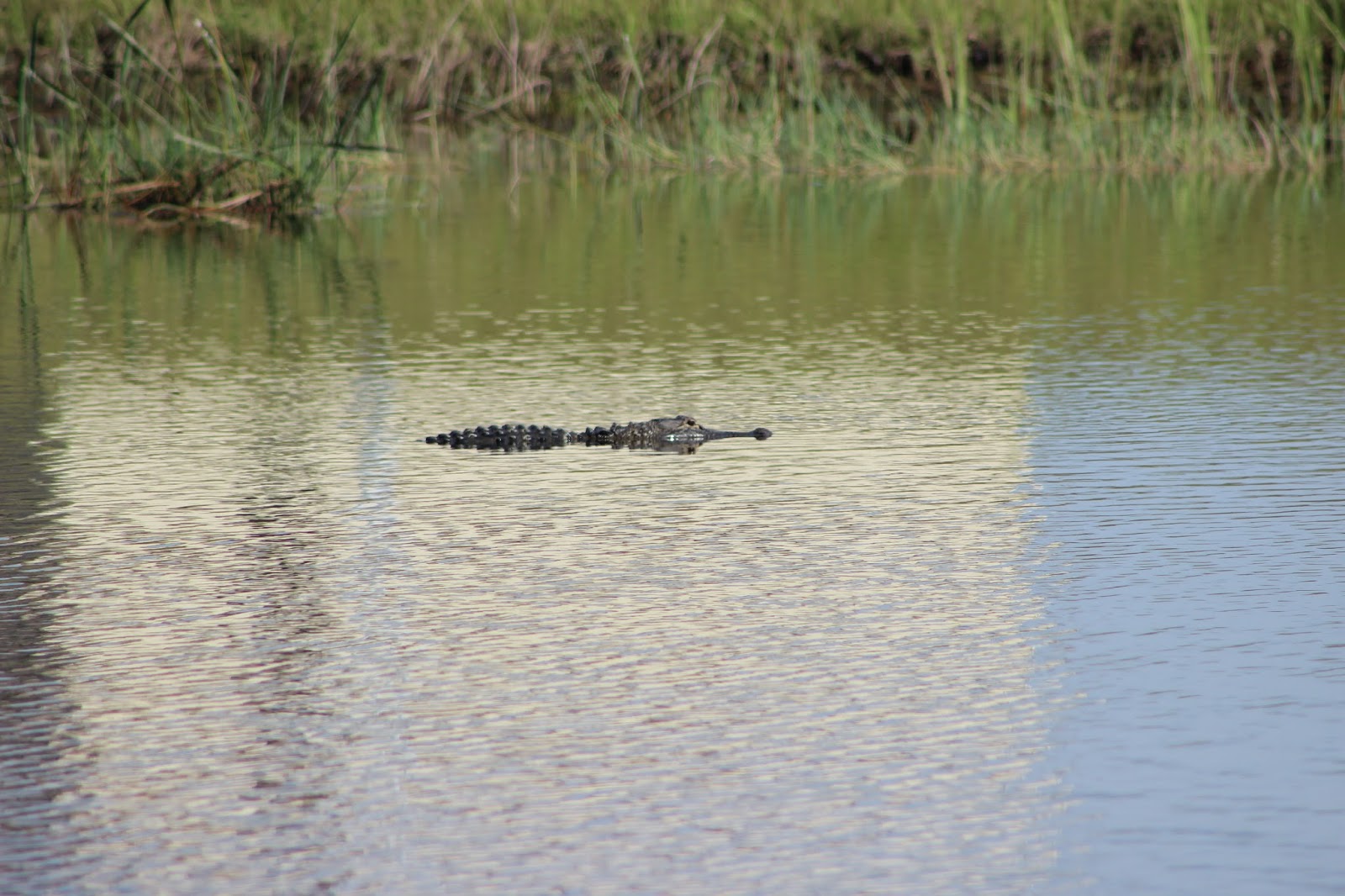
The next day I took a tour of the college and found that its campus was not too shabby as far as nature goes. I saw two Loggerhead Shrikes just hanging out, an alligator in the canal next door, a Tricolored Heron in one pond, and many, many Anhingas. I could take four years of that.


After completing my college visit, my dad and I headed down to the beach at Delnor-Wiggins Pass State Park. I was happily photographing the Willets, Sanderlings, Black-bellied Plovers, and Ruddy Turnstones when I happened to glance up at the sky and saw nothing other than a Magnificent Frigatebird! I almost squealed out loud. I remember reading about MAFRs when I was about ten years old and dreaming of some point in the far future when I would actually see one. Six years later, I was looking right at a beautiful male.

Willet

Black-bellied Plover
Ruddy Turnstone
Magnificent Frigatebird!!

The next day, Thursday, my dad and I drove over to the Fort Lauderdale/Miami area because my dad had a meeting there on Friday. We were surprised to find our hotel was right on the beach, whereas we had thought it was a block or two away. We weren't complaining.
Walking along the beach yielded large numbers of Laughing Gulls, Willets, Black-bellied Plovers, Sanderlings, and Ruddy Turnstones. (And let's not forget the pigeons. Pigeons everywhere.) Also present were Royal Terns, Western Sandpipers, and a lone Herring Gull. To close out our walk, who should make an appearance but another Magnificent Frigatebird!

Brown Pelicans

Ruddy Turnstones

Friday morning meant sitting on the balcony in my pajamas while my dad was at his meeting, scanning the beach with my binoculars. As well as the usual suspects I had counted the day before, I saw Eurasian Collared-Doves, Boat-tailed Grackles, and two flyover Monk Parakeets (lifer!). There was also an American Kestrel perched on the hotel next door, and I probably creeped out the people staying there because I was staring at it through binoculars. It wouldn't be the first time.

Look at all those shorebirds


That afternoon, before our flight home, we decided (or I decided, and my dad complied because he's nice) to check out a local park called Tall Cypress Natural area, which had a lot of good data on eBird. Sadly, however, we went in the middle of the day when not much was out except a multitude of Gray Catbirds and grackles of both the Common and Boat-tailed varieties. While I didn't see the birds I wanted, I was impressed by the rich habitat and biodiversity it had to offer.

Golden-Orb Weaver

Cuban Brown Anole


Florida was cool. I want to go back now.

Saturday, November 7, 2015

Looking Back

Four years. That's how long ago I started this blog. I was twelve years old, with a lifelist of 143 species. I had a point-and-shoot camera (*gasp* the horror!). I didn't know the difference between a Savannah Sparrow and a Swamp Sparrow.
It's so weird to compare that to now--I have a lifelist of 255 species, a DSLR camera that is my best friend, and if I ever called a Savannah Sparrow a Swamp Sparrow I would wonder if I was going insane. I've discovered that birding's not about the lists or the numbers; it's about the birds, the thrill of the chase, and the people you meet.
Birds have always been a part of my life, ever since I could point and yell "Blue Jay!" (which, as it turns out, was when I was about 18 months old). But in these past 4 years I feel like I've grown more as a birder than ever. Trips to Wyoming and Utah, the Delaware Bay (*cough*Camp Avocet was awesome*cough*), and even just out in my local area have really opened my eyes to just how much there is to see and learn.
So yeah, I'm not exactly sure what the point of this post is. I just thought it was cool to think about then vs. now.

 Complimentary bird photo: an Eastern Screech-Owl from Camp Avocet this August.

Tuesday, February 17, 2015

Great Backyard Bird Count 2015

The Great Backyard Bird Count (GBBC) is something I look forward to every year in mid-February, when the weather is bleak and my year list is still in its infant stages. This last weekend, 2/13--2/16, was the GBBC this year, and I have to admit it was one of my favorites so far. I was limited to my yard and neighborhood, but with the oncoming ice storm the birds were more willing than usual to show themselves as they worked up all that fat and energy.

Day 1 (2/13):

I got up relatively early this morning, to be greeted with this friendly face:

Our new dog--Xena, Warrior Princess.


I set out for the patch of woods down the street from my house at around 7:20 AM. Common Grackles were abundant, and I strained my ears to hear the unmistakable call of Red-winged Blackbirds among the grackles' rusty creaks and squawks, but no such luck. The expected Red-wings are a bit late this year. Despite the cold temperature (around 20 degrees, which is pretty cold for Mississippi), the woods yielded 11 species, but surprisingly no White-throated Sparrows or Dark-eyed Juncos.


After birding the woods for about 45 minutes, I walked down our street and around the corner, which was lined with brushy weeds and bushes and pine trees. I got an additional 8 species in that half hour, including a Great Blue Heron that flew from a pond straight in front of me and scared me to death.

Day 2 (2/14):

Besides being Valentine's Day, today was the day we decided to stock up on supplies before the imminent winter storm. So the majority of the second day of the GBBC was spent braving the crowds of people at Kroger and Target. But---I did manage to snare 10 species (including a year bird!) while following my little brother around the yard and trying to keep him from splattering muddy water all over himself and the dog. I'll take it.

Day 3 (2/15):

Today was the most successful day of the GBBC this year. I set out at 2:30 in the afternoon for the same woods I birded on Day 1. The birds were more active today than the first day, probably because of the ice storm that would hit that night. The highlight species was a Golden-crowned Kinglet--one of my favorite birds ever. (Along with Eastern Bluebird, Great Blue Heron, Veery, Baltimore Oriole, Scarlet Tanager...Okay fine, it's really not that hard to get on the list).

Golden-crowned Kinglet


The White-throated Sparrows made up for their absence on Day 1 by appearing in droves on Day 3--I estimated there were at least 100 of them today.


Afterwards I decided to go up to the undeveloped land on the other side of my neighborhood, which proved to be a good idea. There I found several Song Sparrows (year bird!) and a couple of Swamp Sparrows, which was a surprise as I'd never seen them at this location before.

Swamp Sparrow


Before I left, I managed to be startled by a Great Blue Heron again, and flush a very loud Killdeer (another year bird!). I ended the day with 28 species, seen and heard in 2 hours.

Day 4 (2/16):

As I sit here writing on the last day of the GBBC, freezing rain and sleet coats everything in ice outside. White-throated Sparrows, Dark-eyed Juncos, Chipping Sparrows, and a few other species are raiding the feeders, but sadly, I'm not hardcore enough to venture out into the winter weather. Nevertheless, I'm pretty satisfied with this year's GBBC, and I'm looking forward to next year!

Wednesday, March 12, 2014

Birding in My Neighborhood

You know how I said there would be new posts soon? Back in December? Yeah, obviously that didn't really go as planned. This poor blog has been neglected and pushed aside lately, and I will admit that procrastination is one of my best friends. But now I'm back, at least for now, to write a little about the place where I spend most of my time: my house and neighborhood.

The back of our house.


 We've lived in north Mississippi for around 3 and a half years, and I have to say that I love it here. When we moved down here from our tiny town in Upstate New York, I knew I'd miss our fifteen acres of woods and meadow, but I was excited to not have to struggle through hip-deep snow for more than half the year.
Our neighborhood in Mississippi is suburban, but with our five acres and large barn we like to imagine we're still out in the country. We used to have chickens (until they all disappeared one night) and soon will again.

And of course, the birds don't often disappoint either. The first bird I saw at our house was a Mississippi Kite, a lifer back in 2010 and now one of my favorite birds. Since then, I've recorded almost a hundred species in our yard and I'm hoping it won't stop there.
Since upgrading to a DSLR camera, I've been exploring my neighborhood even more. I've found a few places to bird and take pictures, and my little brother (let's call him George) has been pretty enthusiastic too.

A stream next to several houses under construction.


A goldfinch at our new feeder. (That isn't snow; our window was just a little dirtier than to be desired)

Snow Geese we spotted flying over our house during the GBBC.
George learning that dedicated birders sometimes have to endure being mauled by thorn bushes. 

Every day, I'm learning that suburban neighborhoods can have more habitats and species than I previously thought.


Saturday, November 17, 2012

Shelby Farms Park--11/17/12

The morning of Saturday, November 17th dawned cold and clear. It was 6 in the morning, and my dad and I were up and eating breakfast, even though the east was just beginning to glow with the rising sun. I was anticipating a morning of birding Shelby Farms Park in Memphis, TN with the Memphis Chapter of the Tennessee Ornithological Society. I hadn't been out birding in a month and a half, and I was ready to get started.

It was not the best time for birds, though. November is on the border between fall and winter. The trees have (mostly) lost their leaves, but it's not quite cold enough to be winter. The birds notice this, too. The summer residents have gone, the migrants have passed through, but not all the winter residents have arrived yet. November is not known for its "birdiness", but birding is birding, all the same.

We met with the other participants in the amphitheater parking lot at about 7:30. I was surprised at the amount of people there. I was not used to large birding groups, and 24 people seemed like a lot. We broke up into smaller groups, however, with 8 people in each. My group birded the space around the pistol range, as well as the riding stables and Chickasaw Lake.

We had to drive to our destination, and as we followed the group leader, he kept stopping at every bird he saw. He was rather skilled in the art of keeping one hand on the wheel and the other on his binoculars without causing an accident. When we arrived, he lost no time in calling out birds.
"White-throat, White-crowned, Field! Lots of sparrows over here, guys."

Turns out the day was great for sparrows. We saw Savannah, Swamp, White-throated, White-crowned, Song, Field, and Fox. No Vesper Sparrows, though. They're usually seen at that location at this time of year, but we didn't see any. A notable sighting was Gray Catbird. November is pretty late for them, so it was rather unusual.

The brush piles and cotton fields around the pistol range produced many species, including my lifer Winter Wren! I'm pretty excited about that one. One species that failed to show, however, was Lapland Longspur. It's somewhat of a nemesis bird for me, and I was hoping to see one, but we didn't.
After we left the pistol range we headed to the riding stables and Chickasaw Lake. The lake was full of ducks, including Bufflehead, Northern Shoveler, and Gadwall. As well as another lifer: Northern Pintail! We got other new species for our day list as well: Yellow-bellied Sapsucker and Great Blue Heron.
Around this time my dad checked the time, saw that it was 9:15, and decided that it was time to leave. So we did, and left feeling satisfied with another day of birds, birding, and two lifers. It was pretty fun!

Saturday, August 4, 2012

Strawberry Plains Audubon Center-- 8/4/12

The school year has started. That simple phrase can fill some with dread, others with happiness, and still others with a mix of the two. I enjoyed my summer vacation, but I'm excited about the new school year all the same. There are several good things about it. It means I'm in 8th grade (scary thought), it makes the weekend all the more sweet, and........it marks the start of fall migration!

My dad, my little brother and I celebrated by taking a trip to Strawberry Plains Audubon Center in Holly Springs, MS on Saturday. We set out at about 8:15 AM and arrived at about 9. It was supposed to be a group walk, but the leader never showed up. So another very nice person, a mammalogist, drove us to a nearby pond to see some shorebirds. Upon getting out of the golfcart, we spotted a number of small indistinct shorebirds. Determinedly, we raised our binoculars and squinted at them. Our mammalogist guide was at about the same place I am with shorebird identification, so we discussed their field marks until we had to resort to a field guide. We ended up identifying them as Greater and Lesser Yellowlegs, as well as a lone Least Sandpiper.

This photo shows all three species.
The pond was full of many more natural wonders, including turtles, fish, insects, and footprints. We found raccoon, coyote, deer and even bobcat tracks.

Bobcat track.
There were also scores of bird tracks.

A heron track among sandpiper prints.
We looked up from the footprints just in time to see a yellowlegs being chased by.....was that a hummingbird? Those little guys are fierce!

We also noticed about ten turtles sunning themselves on some dead branches sticking out of the water.


As far as we could tell, they were all Red-eared Sliders.

We then decided to move on to the wildflower meadow. The wildflower meadow is an old farm pasture that is controlled with fire and planted with wildflowers. It is a great place to see all kinds of grassland species. It was getting kind of late in the morning, so we didn't expect to see too many birds, but we got a pretty good amount all the same. We heard Field Sparrow, saw White-eyed Vireo and Indigo Bunting, as well as a female Common Yellowthroat; all nice additions to our list. We ended up with 14 species in an hour and a half.


Some of you may have heard of Strawberry Plains Audubon Center's Hummingbird Migration Celebration in September. It is the biggest Audubon event in the country, and it is awesome. It happens this year on the weekend of September 7--9, and I am definitely looking forward to it. The hummingbirds were there in force on Saturday, as we found out when we saw the large collection of hummer feeders at the Center. They were cooperative, friendly, and altogether fun to photograph!


Tuesday, June 19, 2012

Shaw Nature Reserve

 I'm aware that I haven't posted in almost a month, and I am SO sorry! I've been extremely busy, what with summer camps and preparing for next school year.

 My family spent the most of the first week of June in St. Louis, MO; exploring the Science Center, Botanical Garden, Butterfly House, and much more. Well, actually more like re-exploring. We lived there until about 7 years ago, and it's where I was born. Most of the five days we spent there were not spent birding, but the last day, Saturday, we went to Shaw Nature Reserve in Gray Summit, MO; about 30 minutes outside of St. Louis. I decided to write this post in more of a story form, just for fun. I hope you enjoy it too!


The morning of Saturday, June 9 dawned bright and warm. As our family slowly woke up in our hotel in Clayton, Missouri, at first all we could think about was how much our muscles ached from hours and hours of walking around St. Louis's many attractions. My body ached, too, but I thought it could take a little more. I had birds to watch at Shaw Nature Reserve and Arboretum in Gray Summit, Missouri. So did my 9-year-old brother, George, evidently, because the first thing he said when he woke up was "I hope we see a Scissor-tailed Flycatcher today." I was a little surprised. I didn't know he was that in to birds. My spirits were high as I woke the others up.

We were sluggish, but we finally set off at about 10:00 AM for Shaw. As we drove, I tried to think up a list of birds we could see there. I'd heard that Shaw was one of the best birding places in Missouri, mostly due to its habitat variation. It had prairie, forest, glades, and wetland. I'd been there once before when I was about 4 years old, but of course I couldn't remember it much. We were there for their annual Prairie Days celebration, and the only thing I could remember was the insect booth. How it worked was a guy would sit there and ask kids what their favorite insect was, and then he would ask them questions about it. After that they'd get a token. When he asked me what my favorite insect was, I said "Cabbage White", and he just gave me the token. But I couldn't remember the birds, as I was more interested in bugs then.
 By the time we got to Shaw, my mental list included Song Sparrow, Indigo Bunting, Red-winged Blackbird, Eastern Meadowlark, Grasshopper Sparrow, Eastern Kingbird, and Lark Sparrow.

As we pulled into the visitors parking, I looked out my window and took it all in. I could see forest surrounded by prairie scattered with glades, and a large pond over a hill. Paired with the blue sky, it was beautiful.

The view from the visitor center


We all got out of the car, George and I excited about birds, and my 6 year old brothers, Dennis and Huck, excited about bugs. After a quick spray of insect repellent and a dab of sunscreen, we were ready for a great day in the field.

And it was. Within the first ten minutes I had counted Eastern Meadowlark, Song Sparrow, Killdeer, Purple Martin, Indigo Bunting, Eastern Wood-Pewee, and Eastern Phoebe. We had to walk along the forest trail to get to the prairie, and the forest revealed more birds, such as Summer Tanager, Ovenbird, Red-eyed Vireo, and Kentucky Warbler. Ethan walked on ahead and stumbled on a concealed pond. He came running back, claiming to have seen a Little Blue Heron take flight from it. I was a little doubtful, as he often confuses them with Great Blue Herons. But he said it was a lot smaller, and had a darker head. So I took his word for it and wrote that down too. That sighting made Ethan's spirits rise, as it was a lifer for him. In fact, so was Indigo Bunting. He'd never heard or seen one, but they were everywhere at Shaw! They seemed to be singing from almost every tree. I counted 15 by the end of the walk.

Indigo Bunting


Summer Tanager

We finally emerged into the prairie, and were greeted by this sight:


 The prairie at Shaw is some of the last left in the U. S.  Most of it has been plowed for farmland.  But there are still a few pockets of prairie left, and Shaw has about 100 acres of it. The grass can reach 7 feet in September and October, but in June it's about 3--4 feet tall. The prairie is full of life, with over 50 species of wildflowers and insects. There are lots of birds, too--as we found out. Almost as soon as we stepped out of the forest, we heard a Bobwhite from across the field. It was soon joined by 2 others. Male bobwhites usually sing their two-note songs from posts or stumps, where they are easily seen by rivals, but we didn't see any.  I momentarily turned my attention to photographing my non-avian surroundings, and here are some of my results:


If you look closely, you can see a milkweed bug on this.


Altogether, we spent about 2 hours there, and ended up with 29 species. Here's the eBird checklist: http://ebird.org/ebird/view/checklist?subID=S10947110


Friday, May 18, 2012

The Yellow-crowned Night Herons of Midtown Memphis

Wednesday night my dad and I went to the last meeting of the Memphis chapter of the Tennessee Ornithological Society (MTOS) until September. It was the first one I've been to, despite having been a member since December of last year. We'd never been able to make it until then.
The meeting was great and I met a lot of birders. Even, as I was surprised to find, another young birder. Funny, he was the first one I've ever met in person. I was delighted to see that about 25 people showed up. "See," I told my dad. "I'm not that weird."

At every meeting, the MTOS does a talk about something of interest. Wednesday's talk was about the Yellow-crowned Night Herons of midtown Memphis. Apparently, night herons are nesting all over midtown, though people don't often notice them. A lot of them nest in people's yards. Now, that would be cool.
The night herons (or YCNH when abbreviated. Find a chart of standard bird name abbreviations here) have been nesting there for a few years now. I've never seen them, so I made a mental note to suggest it some weekend when we've got nothing to do. The YCNHs usually nest deep in hardwood forests or swamps, and it was a shock to find them in the middle of fast-growing Memphis. Their range includes most of the southeastern U.S., but only the western part of Tennessee. Their range stretches as far north as New Jersey, but only along the east coast. YCNHs also usually nest very high up in trees, but in Memphis they are nesting from only 18 to 20 feet above the ground. The presentation included a lot of great photos, most taken in the breeding season of 2011. They couldn't take photos of the young when they had just hatched, because obviously you can't see them from ground level. There were also photos of courtship and mating, and I learned that male YCNHs, when courting, spread out the plumes on their backs (called nuptial plumes) into a fan that looks almost like a peacock's tail. The guy giving the talk said they get more of these plumes as they get older, so if you see a particularly old male doing it, it's apparently quite amazing.

Young night herons, when they reach about 2 weeks, begin to explore. They move around the nest, which is pretty big, but still crowded with 4 or 5 baby herons in it. Little by little, they make their way to the branches around the nest, where they start testing their wings by spreading them out and making a few expirimental flaps. They, like most babies, are fascinated by their enviroment. A few photos showed the babies perched on branches, looking down with a quizzical expression at cats, dogs, humans, and other curiosities. Occasionally, the baby night herons fall of the branches while doing this. Once they're on the ground, they're pretty much toast. They can get eaten by dogs, cats, or other predators, or just starve or drown.

Yellow-crowned Night Herons are very similar to Black-crowned Night Herons. There are some distinguishing field marks, however--the first one that comes to mind being the color of their crowns, of course--but when they're most active (just after sunset), it can be hard to see colors. So a good way to tell the two apart is their shape. If you stumble upon a night heron, looks at its legs and feet when it flies. Black-crowns tuck their feet up under them, while Yellow-crowns let them trail out behind. It's a good trick to know when looking for night herons. 

YCNHs have a whole lot of unique traits. They are one of the least-studied North American birds, so they might have more. For instance, when a YCNH drops a piece of nesting material, it doesn't fly down to pick it up. This is strange, because every heron species we know of picks up the material if it drops it. Not Yellow-crowns, though. YCNHs also don't prefer getting their feet wet. They live in marshes and swamps, eat crabs and crayfish, and are called long-legged waders, but don't like to get their feet wet. Kind of strange. Another trait they have is also claimed by other heron species. One of their first methods of defense is their stomach. If some kind of predator is climbing their nest tree, they'll lean over the side of the nest and--WHAM. Deflate their stomach. If you're a researcher or biologist of some kind, and you want to see into a heron nest by climbing up their nest tree, they'll do the same to you. The guy giving the talk said it happened to him with Cattle Egrets in Hawaii. He said it was worse than being sprayed by a skunk. Ew.

So now I have another bird on my wish list.


Monday, May 14, 2012

A Birding Update

Saturday, May 12, was International Migratory Bird Day. The Memphis chapter of the TN Ornithological Society (of which I am a member) hosted a Shelby county Migratory Bird Count, but I was unable to participate because my brother had a baseball tournament and I live in DeSoto county, not Shelby. I'm sure there were other counts in other places, and if you participated in one I'd love to know how it went! Just leave me a comment down below.

Friday was the first game of my brother's baseball tournament. He's on the Blue Jays, but their uniforms look more like the White Sox and the players sound more like the Braves (southern accents :D) . They're a rec team, but they were playing competitive teams from other towns. They lost every game, but they did well considering who they were up against. My 3 littlest brothers made an interesting discovery that day. They, while running around with their friends, stumbled (thankfully not literally) upon a Killdeer nest.

It was just outside the fence around one of the ball fields; one of the worst places it could have been. There were little kids and baseball players everywhere! I tried to get my brothers and their friends away from the nest, but they seemed not to hear my saying "If you stay here the mother bird won't come back". So I switched to "If you stay here you'll get hit by a ball", as there was a team warming up very close to us, and promptly got hit in the foot myself. "Sorry," said the player. "No problem," I replied. "Thanks for illustrating my point!"

I finally did get the kids away from the egg, but the adult Killdeer was still going berserk. There were at least 20 people way to close to her egg for her liking. Unfortunately, there wasn't much anyone could do about it. She had picked the second worst place to nest in the whole ballpark. The worst would be the parking lot. Or the sidewalk. Or home plate.

When I came back on Saturday I didn't get a chance to check on the egg, but the adult Killdeer was still hanging around there. I hope she successfully raises a chick!

I also recently discovered a Cardinal nest in one of our bushes. The day I found it there were three eggs, and the next day, May 10, the first chick had hatched. The day after that, all three chicks were out of their eggs.

The first chick


I also have been having a whole lot of dreams about birding this week. Is that a sign? I've had one about an Ivory-billed Woodpecker showing up in our yard (I've had a bunch of those), a dream about finding a flock of Northern Gannets while birding the Tennessee River (is that even possible? Probably not), and a dream about finding a Lesser Yellowlegs that turned into a Prothonotary Warbler. Now that one was weird.

And that's pretty much all the significant birding I've done in the past few weeks. I've never been able to get out much; I'm lucky if I get to go birding once a month. I try not to complain, but I'm becoming very twitchy. One of my major goals is to learn how to drive so I can chase after every rarity I can get to. That should give my life list a boost.

I have gotten a few year birds, though. I saw Common Nighthawk at the ballpark about 2 weeks ago. Also when the whole family went fossil hunting at Coon Creek Science Center in McNairy County, TN a few weeks ago, I did a lot of birding by ear, adding much needed species such Black-thraoted Green Warbler, Yellow Warbler, Field Sparrow, Ovenbird, and Indigo Bunting.

But I just finished reading Kingbird Highway by Kenn Kaufman, and as anyone who has read the book can recall, near the end he starts to lose his interest in listing as he realizes it's not the important part of birding. He comes to know that the most important part of birding is the birds; finding them, studying them, knowing them. After reading that, my life list of 163 and year list of 77 doesn't seem so pitiful after all. But it's still fun to look for the birds and try to get as many as you can on one list. And you know you're not getting enough when your wish list is longer than your life list. :)

Happy Birding!


P.S: Does anyone have any tips on identifying shorebirds? I'm trying to work on that, but I haven't had very many opportunities to practice. Any help is appreciated!


Tuesday, May 8, 2012

Sunday, April 15, 2012

Migrant of the Week 4/15--4/21 2012

Today, April 15, the American Birding Association's Young Birder of the Year contest starts! To find details (and to see the winners of last year's) click here. To celebrate, I have chosen for this week's migrant, a bird that all birders long to see, North America's rarest warbler. The Migrant of the Week 4/15--4/21 2012 is.....

The Kirtland's Warbler!
 An amazing bird.


Random Cool Facts:

Like I said, the Kirtland's Warbler is the rarest warbler in North America. All known Kirtland's Warblers breed in the jack pine forests in Michigan and winter in the Caribbean. Jack pines depend on fire to survive, because their pinecones open only after being exposed to high temperatures of at least 122 degrees Fahrenheit.  It is a large warbler of the family Parulidae. Like the Palm warbler, it constantly pumps its tail.


Identification:

The Kirtland's Warbler is a small, chunky songbird, but large for a warbler. Their upperparts are bluish-gray to dark gray; their underparts are yellow, with black streaks on their sides. They have two crescent markings around their eyes, one above and one below. They forage for food from the mid-levels of trees to the ground.  Photo accredited to the Cornell Lab of Ornithology:


Nesting:

Kirtland's Warblers build their open cup nests out of grass, pine needles, and leaves. They line them with hair, rootlets, and plant fibers. They nest in depressions on the ground, often with a tuft of grass overhanging the nest. A full clutch is 3--6 white or buff eggs with light brown spots usually concentrated at the end. One brood per year.


Kirtland's Warblers are in danger of extinction because of habitat loss, and some years because of lack of fire. They deserve our help as well as the title of Migrant of the Week.


Note: I don't know as much about Kirtland's Warblers as I do about other species, so if you see something wrong with this description and life history, please let me know in the comments. Thanks!

Monday, April 9, 2012

Migrant of the Week 4/8--4/14 2012

I recently came up with an idea to write a post every week during Spring Migration (assuming I remember) about an interesting migrant. It'll be a different one each time. I'm a little late with this one (as it's Monday already), but as they say, better late than never. So without further delay, the Migrant of the Week 4/8--4/14 2012 is....

The Red-eyed Vireo!
I love this bird :).

Random Cool Facts:

The Red-eyed Vireo is a delightful little bird in my opinion. It is one of the first vireos to return to its breeding grounds in the spring.  It is one of the most common birds in eastern forests of the US, and is often heard rather than seen. They usually sticks to the tree-tops, foraging for insects. They nest rather low, however, and are a popular host for Brown-headed Cowbirds. Red-eyes grow up to 5.1 inches long, and way only 0.4-0.9 ounces. Red-eyed Vireos living year-round in South America may be a separate species.

Identification:

Red-eyed Vireos are quirky little birds with bright red eyes (as their name suggests), a dark eyestripe, an olive-green back, whitish underparts, and an attitude. They are overall a small, drab bird, but still very enjoyable to chase after on sunny mornings, I've found. Immatures have brown eyes and yellow underparts. The adults' other field marks include a gray to smoky blue crown, and a white supercillium (which, in case you didn't know, is just a fancy way of saying "eyebrow".)

Voice:

Red-eyed Vireos have a very distinctive song, which sounds like "see me; here I am; way up; in a tree". They will sing this for hours without a break. The song is similar to the Blue-headed and Yellow-throated Vireos', but is much faster. to listen to a recording, go to: http://www.allaboutbirds.org/guide/Red-eyed_Vireo/sounds. Their call is a catbird-like "myaah".

 Nesting:

The Red-eyed Vireo builds its nest rather low for a bird that spends most of its time in the tree-tops. As I said before, they are a popular host for Brown-headed Cowbirds. The female builds a cup nest of bark, grass, spider webs, and other plant material. She usually lays 3-5 eggs. The male and the female feed the young, who leave the nest after about 12 days. They occasionally raise 2 broods in a season, but just 1 is more common.


Red-eyed Vireos are very, very interesting birds, and I think they deserve the title of Migrant of the Week.


Friday, April 6, 2012

Breaking News: Female Cornell Heron Lays a FIFTH Egg!

I know! It's amazing, isn't it? At 2:20 AM EDT (or maybe a little earlier) this morning, the female of the Great Blue Heron pair the Cornell Lab of Ornithology is monitoring laid a FIFTH egg. We didn't see that coming. A full Great Blue Heron clutch is 2-4 eggs, but 5 has been recorded on rare occasions. But every time, the fifth chick was tiny and usually ended up dying. Now I'm worried.
Someone watching the cam apparently found a website that said herons lay 4-7 eggs, but only 4 hatch. Cornell, instead of denying it, demonstrated their great sense of open-mindedness by saying, and I quote "I guess we'll have to find out!" :) I love them.
Now a little about the Cornell Herons:

In spring 2009, the Cornell team was delighted to find a Great Blue Heron pair building a nest in a dead oak in the pond right next to their Johnson Center for Birds and Biodiversity. It was the first known Great Blue Heron nest in Sapsucker Woods. The herons successfully raised 4 young that year. They came back in 2010, and raised 4 young again. And they did the same thing in 2011. We can't be sure the female is the same from all the years, but the male is missing his back toe on his right foot, so we're certain he's the same as every year.


                                         All photos accredited to the Cornell Lab of Ornithology


The female right after she laid her 3rd egg.

Mom and Dad at the nest.

The Lab was able to document never-before-seen behavior, such as egg-laying shown here.

The Herons also offer great entertainment!


If you would like to see the webcam, (and I'm sure you do) here's a link. There is also a chat that goes along with the cam, which is monitored by the Lab. If you have questions, or just want to talk about birds, you can chat with other people just like you.


Tuesday, February 28, 2012

Winter Bird Highlights

What? Is it really time for winter bird highlights? When we lived in upstate New York it was time for tapping the maple trees, not compiling bird records. But since it feels like spring already, (especially today; it's about 65 degrees) with the daffodils and pears and cherries blooming, I might as well do it. This winter as been the weirdest one in a long time, with snow in November here, and no snow up in New England for a while. Bird reports have been just as strange. The Snowy Owls have been moving south; the GBBC had around 600 reports in 29 states. And Whooping Cranes have been reported wintering in Indiana and of course in north Alabama, where Operation Migration's flock is wintering at Wheeler NWR. Altogether, the winter of 2011-2012 has been memorable to many birders. The rarities are still coming. The Painted Redstart is still near Ocean Springs, Mississippi (on the Gulf), and a Pink-footed Goose has been spotted in Maryland and places near there. This last one is especially weird. Pink-footed Geese are extremely common in Europe and Asia, and are hunted for sport. But in North America, a Pink-footed Goose is something to wonder at. Dickcissels are moving east, with lots of sightings in Massachusetts, Rhode Island, and other places throughout New England. The sightings here in north MS have also been unusual. In the Memphis Chapter of the Tennessee Ornithological Society newsletter, I saw reports of Red Crossbills, a Short-eared Owl, Yellow-headed Blackbirds, and more. But birds in my yard have been pretty much normal. In December, though, we did have our first flock of House Finches since we moved to north Mississippi. Also, I have confirmed that mystery hawk as a Red-shouldered. Why was it so hard? It seems obvious that it wasn't a Broad-winged now. Sometimes, I just need to stop and look closer, I guess. To find more info on how birds are doing, click here. It's a link to a part of the eBird website where you can view maps of data. If you click on "Line Graphs", it will ask you to enter a species name. Once you do that, you can see how that species is doing in a location. You can actually enter more than one species, and see how each of them is doing. You may already know this, but just in case, I'm telling you. 

Also, I took some photos yesterday that I wanted to share. Here they are:

 Northern Mockingbird.


Cherry blossom in the sunset.

Experimenting with shadow photography.

My trusty Bushnell Spotting Scope. (Looks cool in black and white :)

The pear trees along our neighbors' driveway.


Grackles and Red-winged Blackbirds.

The sunset. My camera was running out of batteries, but I couldn't resist taking this photo.


So I hope everyone's year lists are nice and long already and they're having a great winter/spring!